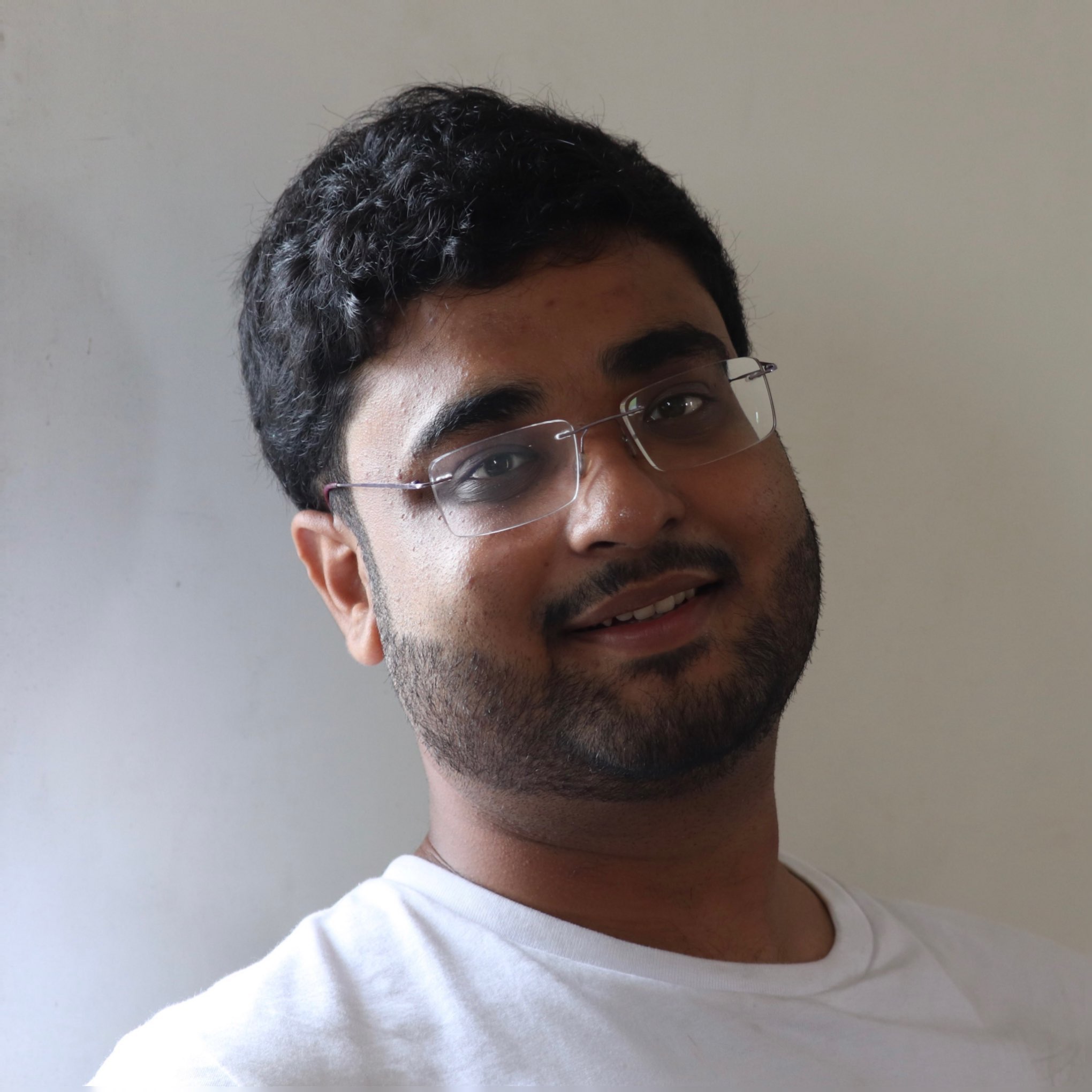
Something I want to clarify for readers of this webpage: This is my professional webpage written from my personal point of view and I have different optinions on learning vs research. For me, learning includes research; I refer to learning from a book/paper/others as second-hand learning and learning from my own insights/research/results as first-hand learning. So if you see the word 'learn', it does include research sometimes. I have a strong urge to do second-hand learning from experts only, because of my strong belief that second-hand learning, by definition, cannot be done third-hand.
My learning interests lie in applied areas of Distributionally Robust Optimization, Polynomial Optimization, Applied Algebraic Geometry and theoretical Machine Learning. I love solving problems (and mathematical puzzles), especially those similar to olympiad style and competitive coding problems.
[05/26] Research visit to the School of Computing and the Department of Mathematics at the National University of Singapore hosted by Jonathan Scarlett and Yong Sheng Soh respectively. I'll be working from May to August 2026 on contextual bandits with Jon and Chenkai and on developing a theory of optimization over convex bodies with Yong Sheng and Oscar Leong.
[05/25] Research visit to the School of Computing at the National University of Singapore hosted by Jonathan Scarlett. I'll be working from June to August 2025 on distributional robust optimization in contextual Bayesian scenarios with blackbox access.
Join a supportive research position (including academia and industry) to learn more about aspects of ML, and optimization, and use them in real-world problems.
Education
Doctor of Philosophy
Sep 2022 - (expected) 2027
Rutgers - the State University of New Jersey
Mathematics
Master of Science
Sep 2022 - May 2024
CGPA: 4.0 / 4.0
Bachelor of Science (Hons)
Aug 2019 - May 2022
Chennai Mathematical Institute
Mathematics and Computer Science
CGPA: 9.72 / 10
Position: 3rd (out of 57)
Indian School Certificate Exam
2019
Don Bosco School, Liluah
Science stream
Percentage: 97.25%
Position: 2nd (in a batch of ~180), 1st (in Science batch of ~55)
Indian Certificate of Secondary Education
2017
Don Bosco School, Liluah
Percentage: 96.6%
Position: 1st (out of ~180)
Usage of AI
I am an avid user of AI tools like ChatGPT and sometimes Gemini and Claude. Besides using it for small questions like first-aid tips, recipe planning and trip planning, I extensively use them for mathematics. My experience so far has been that it has not been able to solve any of my problems completely. It may be either due to limited mathematics ability of AI or due to my poor prompting skills. However, these models have given me successful insights into my problems a few times. These might include reframing or weakening a lemma to reach the target theorem or get a different perspective on a problem (for example, a geometric or analytic or a computer-science perspective on a problem is oftentimes useful because my mind is trained to be an algebraist). Besides this, I regularly use it for reshaping my writing -- for example, getting rid of redundancies, drawing tikz pictures, framing a sentence precisely, generating small examples for enhanced user readability or fetching bibliography references and doing literature reviews.
Despite the lack of ability to completely prove results for me, ChatGPT has been extremely useful for my learning experience. Getting the gist out of a big paper is a challenge I face till this date. These LLMs are really good at explaining theorems and demonstrating them to me via examples. I have figured out that the best way for me to learn is via examples and always stress-testing lemmas (I never knew the term "stress-testing" until recently). This is really helpful for me because mathematicians always tend to ask "what if this assumption was weakened". I am not talking with respect to research, but just for understanding a theorem or a concept. I no longer have to wait for a meeting with an expert to ask a question about examples because ChatGPT can answer my conceptual questions and paint an overall picture for me. However, I still find it a little annoying that its perspectives on every concept is quite biased towards one community -- the community which works the most on that type of thing. For example, I was once seeking a geometric view for a question in coding theory, which it completely failed at, whereas my collaborator, an expert in algebraic geometry, had painted the exact picture I had wanted.
(May 2023) Attending as the head counsellor at PROMYS India.
(Jan-Apr 2023) Organizing ANGeLS - the Algebra and Geometry Learning Seminar for graduate students. Please drop by at HILL 525 at 9AM every Wednesday to enjoy bagels over some wonderful talks on Quiver Representations.
A self-contained proof of Pisier's inequality at Princeton for the course on Convexities Notes.
(Not a talk)
My scribed lecture for some random matrix concentration inequalities at Princeton for the course on Matrix Concentration and Applications Notes.
Well-definedness of the Brauer group at Rutgers Algebra aNd GEometry Learning Seminar
Reference: Associative Algebras by Pierce.
Fiedler Vector Methodat CMI for the course on Matrix Computations
These are the slides, written report, and video based of a group project on the Fiedler vector method - an approximate way to find a balanced graph cuts. Slides.
Report.
Video.
Cantor Set
Here are the notes for a talk on Cantor set I gave in a tutorial in Graduate Analysis I course. Notes.
Markov Chain Monte Carlo
This is the presentation based on an internship with Prof R V Ramamoorthi. Presentation.
Quantum Computing
These are the write-ups for a series of four talks I gave at a PROMYS counsellor seminar on Quantum Computing. Talk 1.
Talk 2.
Talk 3.
Talk 4.
Lie Algebras and their Representations
These are the slides and the writeup for a series of talks I gave at a PROMYS counsellor seminar on Representation theory of Lie algebras. Writeup.
Talk 1.
Talk 2.
Talk 3.
Introduction to Hyperbolic Geometry
These are the write-ups for a series of four talks I gave at a PROMYS counsellor seminar on the calculus on the upper half plane in Hyperbolic geometry. Writeup.
Computer Project in grade 12
These are the project writeups for my project for grade 12 in high-school. One is a compilation of codes we did throughout the year, another is a larger project to imitate a retail shop and implement an inventory of items. Compilation. Inventory Code.
Access your CMI account remotely
This is an article about accessing your CMI account sitting at your home. This allows you to do a few things like opening CMI local links and creating your own homepage - and any other task for which you want local access to a physical computer at CMI.
Distributing grade details in the online semester
This is an article for graders to share information with their students, keeping all the information available to them. I wrote this article in hope that graders learn and use new techniques, in order to adapt to the online semester. Technology should not be interfere with one's right to information. Hope that this article gives some momentum.
Distributing grade details in the online semester from your university mail (secure)
This article does the same job as the previous article. The only difference is that the email id, from which mails are sent, is the user's university account. This makes use of the mail command in Unix. This much more secure, because one will be using the institute's local machine to send all mails.